Monday, 31 January 2011

Boeuf Bourguignon

Yesterday I went down to our nearest town Preuilly sur Claise to see some friends of ours who were hosting a 'New' New Year's party in aid of  Australian flood relief. Susan and Simon are Australian and used to live in the Queensland area which has been so badly affected. Niall didn't come as he had a flu-y cold and was sneezing fit to shake our rafters.
January, Tres Riches Heures de Duc de Berry, folio 2r

It was nice to meet people, some of whom I'd never met, but knew through their blogs. I didn't stay for lunch--the party was in the morning to co-incide with another being held in Australia-- I was making boeuf Bourguignon for dinner and although the preparation doesn't take a lot of time the cooking does.

We buy most of our pork and beef from a local farmer, Christophe who sells to the public as well as to trade. Just before Christmas we'd bought a 5kg caisson (box) of beef. We'd had 5 kg of pork from him in October which was excellent. The caisson is a mixed range of good cuts. The beef box contained: sausages, entrecotes, minute steaks, a larg-ish pot roast and stewing (Bourguignon) beef. So far we've had some of everything except the stewing beef and the pot roast; and it's been lovely.

So now it was the turn of the boeuf Bourguignon. During the week I'd received a parcel from my sister in law which included the dvd 'Julie & Julia' --brillaint timing on her part. It's a film which entwines two stories about cooking and food. Story one is about Julia Child, a culinary legend in the US whose book 'Mastering the Art of French Cooking' is the cornerstone of French cooking in the US. Julie is 'a writer in the making' who decides to set herself the challenge of cooking all the recipes contained in Julia Child's book in a 1 year and to recount her progress via a blog. The dvd came with a 'freebie'; a little mini book containing 30 recipes from  'Mastering the Art of French Cooking'; it included Julia's recipe for boeuf Bourguignon.

When I was a child her book was gospel in my mother's kitchen , and my mother, who had lived and worked in Paris in the 1950's for a number of years, knew a thing or two herself about French cooking. I can also just about remember us watching the Julia Child's TV show in the late 1960's. These must have been re-runs as the original series was broadcast in 1963 and I couldn't have seen that.
Julia Child's cookbook

Anyway back to the boeuf Bourguignon. Mine is a simplified version when compared to hers; but I do agree with her that your meat has to be dry otherwise it won't brown properly and good browning does make a real difference. I'm notorious for not really weighing or measuring things in details so apologies for the lack of precise quantities but here's my version for 3 to 4 servings:

Ingredients:
1 packet of lardons
cubed good quality stewing beef--probably about 450g; dried off (use old tea towel)
clove of garlic
2 large carrots finely chopped
1 onion chopped
2 shalottes chopped ( I don't like little silver onions so use shalottes ; but traditionally one uses silver onions)
bouquet garni
flour to coat the meat
butter
between 300 and 500 ml of beef stock
about 3/4 bottle of red wine
sauteed mushrooms to add in at the end of you want

use a good cast iron casserole pan which you can put in the oven
pre-heat your oven to 175/180C

I gently fry off the lardons, crushed clove of garlic and onion and then remove them from the pan. In the lardon fat I then brown the beef.
Once the beef is well browned I add the lardons, garlic and onion back into the pan, add in a knob of butter and sprinkle the whole generously with flour. 
Stir it round to make sure everything is well coated and well absorbed--don't worry if it begins to cake to the bottom of your casserole.
It will 'dissolve'  when you add the liquids --which is what you do next.
Don't add it all in one go but put in about 1/2 the stock and stir well. Then add the other half of the stock. Give it another stir and add the red wine somewhere between 3/4 and a whole bottle. If you don't mind a slightly wetter stew add the whole bottle of wine.
Add in your carrots and shallots [silver onions]. 
Everything should be just covered by the liquid.
Add the bouquet garni and put in the oven for about 2 1/2 to 3 hrs.
Just before the time's up sautee off your mushrooms and then add them to the casserole.

We had our boeuf Bourguignon with new potatoes and nice bottle of Touraine red --yum-- and watched the dvd in which boeuf Bourguignon certainly features! And today we had second helpings for lunch. Personally I think it probably tastes even better re-heated.

Saturday, 29 January 2011

Cassini and our 'Lieu Dit'

ruin which is next to our chemin
We live just about 1.2 km outside of the village of Charnizay proper in what is called a 'lieu dit' (literally 'a place called') which is as small as you can get. Next up would be a 'hameau' and the next up from that a 'village'. The sun was out so we decided to have a nose around the ruins, being careful not to step on the daffodils which were beginning to show here and there.

house which has fireplace
Originally our lieu dit had a number of houses--all, except ours and the neighbours are now ruinous and almost completely reclaimed by the woods. As some buildings will have been barns or out buildings it is hard to say how many houses there were exactly; but we think there were at least another 2. One of the ruins has a bread oven (more modern brick-work than ours) so it could be part of a house; certainly the windows which still have some of their frames would suggest so. Another of the ruins still has its fireplace and also has the remains of window frames, in fact there's even some glass still hanging in there for grim death.

window frames still in evidence
We know from the maire that up until the 1960's all the houses were lived in. He remembers it as it was. Evidently there were a number of families and quite a few children. There is a communal well which we've mentioned previously and the houses are roughly scattered around it.

What we'd really like to know is how old the lieu dit, and specifically, our house is. We know we'll never get an exact date but a ball park idea would be nice. We thought we might be able to go a bit further back using old maps.

In the 18th century four generations of the Cassini family set out to map the country of France. They did so with great accuracy and throughness; taking full advantage of improvements in astronomy and used triangulation for accuracy. As they travelled around the country they often encountered deep suspicion and even hostility.

At the iGN website (use this link) there is a bit of general information on the Cassinis and you can click on Cassini maps link at the bottom of the page. This takes you to GeoPortal where you can type in your address. You are then presented with 3 maps each over laying the other. Top is the original Cassini, next is the iGN's (French equivalent of Ordinancy Survey) and third is an ariel photograph. You can vary the opacity of each so that they work as transparancies. What is so impressive is that the mid 18th century Cassini map is pretty much bang on when compared to the modern iGN map. The originals of these maps are in the Bibliotheque National in Paris.

Tinka 'exploring' the un-used well
To our delight our lieu dit was clearly marked so that takes back to around 1750; another 65 years earlier than the grafitti near the barn (see a previous post).

If you are interested Graham Robb's book "The discovery of France" is a good read and tells the story of early cartographers in France.

Wednesday, 26 January 2011

Burn's Night

a stabbed haggis; photo:londoncityairport.wordpress.com
Yesterday, 25 January was Robert Burns' birthday-- hence Burn's Night when Scots traditionally eat a haggis supper; haggis, tatties and neeps washed down with good quantities of malt whisky.

The haggis is brought to the table with great ceremony to the tune of bagpipes; and is then 'addressed' by a gentleman who reads Robbie Burns' poem 'To a Haggis' and finishes by stabbing it with a Skean Dhu (ceremonial dagger). If you want to find out more about the poems of Robbie Burns, or hear them read visit the BBC's website  
 
At a later point during the dinner it is traditional for a different gentleman to give an address 'to the lassies' (a speech to the ladies). There is no corresponding 'address to the laddies'.

For those of you who have no idea what haggis is; well it won't win any awards for the best looking dish but when done right it is a very tasty dish indeed. Traditionally, if you live in Edinburgh one of 'the' places to buy your haggis is from MacSween's butchers.

Haggis; photo from www.epicerie-ecossaise.com
What's in it? Scare stories abound of haggis and, yes originally it was a recipe which used up bits of the animal which would otherwise go to waste and so contained "pluck": lungs, liver and heart.  However, today a haggis is much more likely to contain lamb shoulder and kidneys and beef liver as well as the traditional oatmeal, herbs and spices. In the UK haggis is made with suet (hard beef fat) but due to BSE this is no longer allowed for export, so for the EU lamb fat is used instead. The bit that continues to make many people go "eeeeuuuuw" is that the whole is cooked in a sheep's stomach. A well cleaned out stomach I hasten to add. Premium sausages are cased in intestines and nobody goes "eeuuw" --well not too often--  about that. In the land of andouillettes (tripe sausage) and boudin noir et blanc I doubt haggis ingredients will raise much of an eyebrow.

When we first lived in the Netherlands internet shopping was still in it's infancy and getting hold of haggis for a Burns Night Supper was a challenge--we found one Scottish restaurant which made its own and sold to order. Now such things have become so easy. A quick internet search revealed serval options for getting haggis delivered. We are still finding our feet; but we'll see for next year....

Sunday, 23 January 2011

Snow flurries & snowdrops

Yesterday we got on with some outdoors stuff.  We saw Eric out too, putting some fertilizer on his wheat; he farms the field on our north border. Our woodshed needed topping up. So while Niall got on with that I made a start on tackling the various bushes and small trees that had been left to run riot.

Eric's field looking NW towards other side of valley
We don't want a manicured garden--it wouldn't suit; but we do want to try and keep things healthy and vigorous.

Layered in various fleeces and hats we got stuck in. 30 mins after we started we realised it was snowing-- those tiny flakes that look like minute styrofoam balls. Joy! It didn't last but the wind stayed pretty perishing, blasting in from the NE across the ridge. A far cry from having the sunroof open for a bit last Sunday! Thankfully the house gave some shelter as we were working on the south side.

We have various ramblers against the house and barn as well as dogrose bushes. I pruned them back hard, dealt with an over enthusiastic Clematis and made a start on the lilac bushes which have loads of suckers and quite a bit of deadwood to remove. Not sure what emerged from under the Clematis--I think it's a type of ornamental cherry.

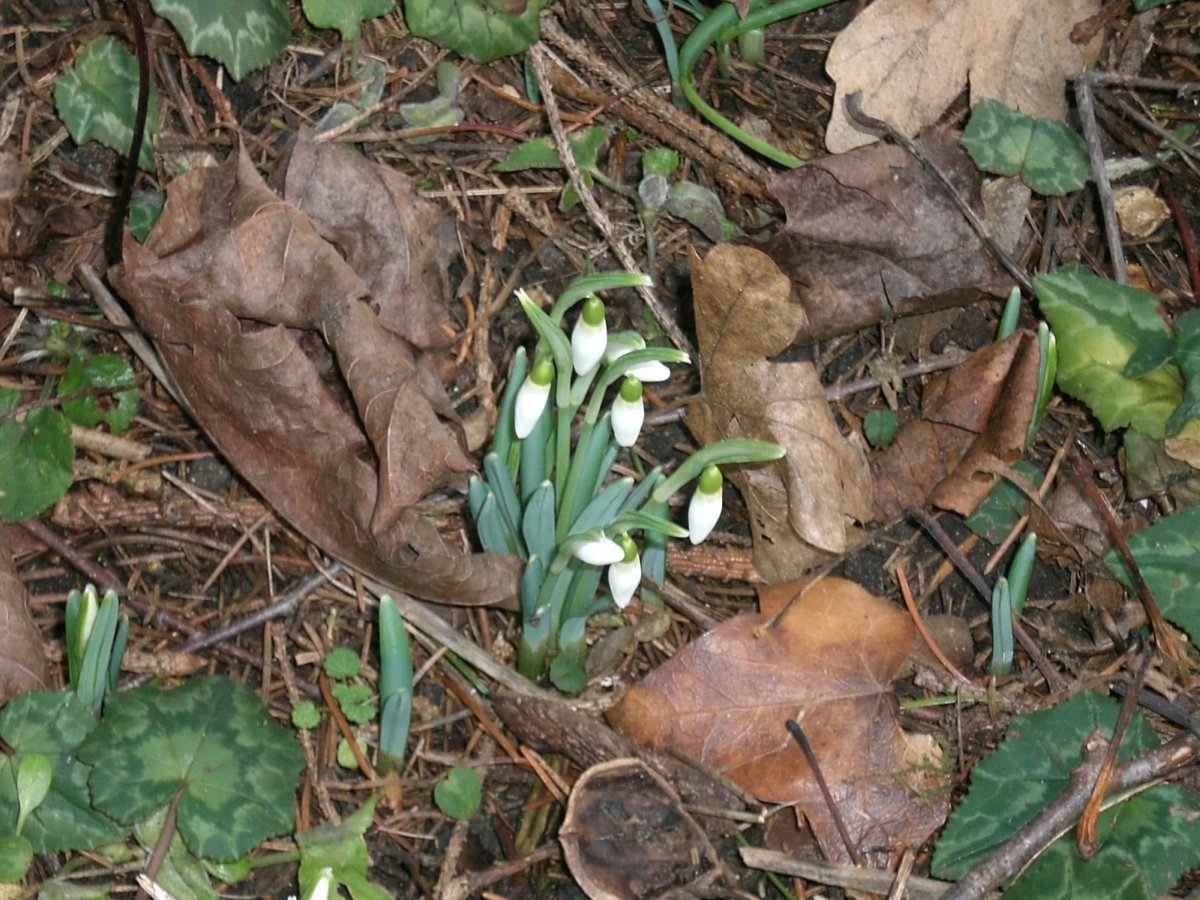
first snowdrops
It will be exciting to see everything flower and find out exactly what we've got. On the list for next time is the fig and a cherry. The cherry has seen better days but we may be able to re-invogorate it now that the enormous hazel bushes were dug out last October. They were stealing all the light so things have gone weedy. Underfoot amongst last fall's leaves we spotted the first tiny primrose leaves and some snowdrops. The snowdrops led to some silly contortions round one of the lilac bushes as I tried very hard to avoid standing on them.
Naturally Katinka was dashing about 'helping'. Her newest party trick is to get under the blue tarp covering one of the woodpiles. It looks just like the tarp is having convulsions! 
Just before writing this a flock of green finches and one of chaffinches as well as a hawfinch swooped in. They obviously all appreciated the disturbance created yesterday and were rootling about eagerly turning over the leaves in search of food. And just to prove we didn't totally eradicate the hazel bushes and that we are moving --slowly-- towards Spring a pic of the hazelnut catkins.
catkins 23.01.2011

Friday, 21 January 2011

Wood baskets

Since we've come here to live permanently we go on the odd jaunt to re-acquaint ourselves with places in the area we've visited  before-- we first started coming to this region in 1991--but haven't been to recently, or sometimes, eons ago.

On one of these last autumn--probably early October; we went back to Fontrevault. We'd been there quite a few times but the last visit had been long ago and it was interesting to see what had changed. More of that another time.

On leaving Fontrevault we ambled off to Azay le Rideau and over lunch there remembered that Villaines-les Rochers wasn't far away. We'd been talking about the installation of our woodburner and discussing how many 'stares' (1 stare = 1 cubic meter) of buches (logs) we were going to need. 

Villaines-les-Rochers is the center for 'vannerie' all things made out of willow; and we needed a log basket. They've been growing the willow for withies to make household wares in Villaines since the 7th century.

collection of willow work
Like many traditional crafts, vannerie was piece work and paid by the item. The craft was passed from father to son. This old black and white postcard on the left shows a great selection of vannerie. 

The craft fell into decline but in 1975 they formed the Societe Cooperative de Vannerie Villaines-les-Rochers which now trains people from all over France, offeres demonstrations of willow weaving and sells the handmade items.

quality label

In good French tradition the co-op is very proud of the quality of its merchandise and every object comes with a tag certifying that is genuine vannerie from Villaines-les-Rochers. All along the main street of Villaines there are street decorations attached to the sides of the houses in the shape of 2 dimensional baskets. Just like old fashioned shop signs promoting their wares.

We had a lovely root around the shop-- looking at the historical displays and comparing log baskets to log trugs before finally deciding on a log basket. It has seen good service with the snows and freezing weather in December. Last week it had a bit of time off as it was so mild but this week with the drop in temperatures it has been in very active service again.  
well used log basket